
PET, APET, RPET Thermoforming Material Overview
PET (Polyethylene Terephthalate), for use with trays, clamshells, blisters and covers, is the broad umbrella term for the thermoplastic polymer family. Polyethylene Terephthalate (PET) is a highly versatile, thermoplastic polymer resin of the polyester family.For thermoformed packaging, understanding the nuances between standard PET, APET, and RPET is critical for specifying the correct material for your application’s mechanical and environmental requirements.
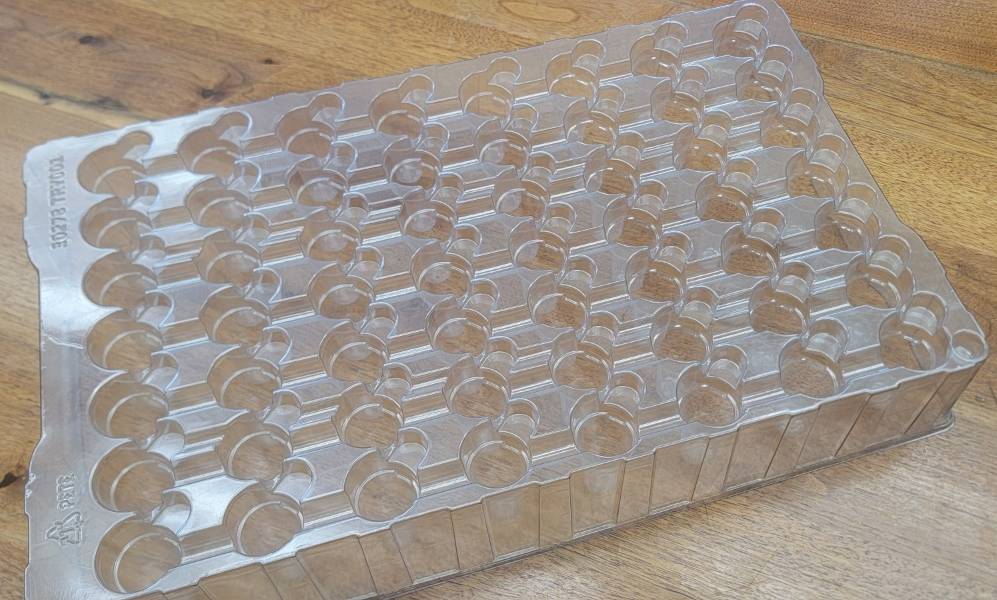
Here is how APET compares to the other primary variants in the PET material family:
| Material Grade | Full Name | Primary Characteristic | Typical Packaging Application |
| APET | Amorphous PET | Highly transparent, rigid, low heat resistance (< 60 degrees Celsius or 140 degrees Fahrenheit) Note: Un-crystallized | Thermoformed clear trays, clamshells, blister packs |
| PET | Virgin Grade PET | Virgin Grade allows for 100% traceability. Heat resistance between APET and CPET | Industrial Medical Trays, Optics Trays |
| PETG | Glycol-modified PET | Softer, higher impact resistance, lower melting point | Medical device packaging, heavy-duty blisters, gamma-sterilized trays |
| RPET | Recycled PET | Made from post-consumer or post-industrial scrap | Eco-friendly thermoformed trays and clamshells (usually blended into APET) |
| CPET | Crystalline PET | Opaque (white/black) high heat resistance (up to 220 degrees Celsius) | Dual-ovenable food trays (freezer-to-oven) |
REASONS for specific PET materials
- Thermal Limits: APET loses structural integrity above 60°C (140°F). If the tray needs to undergo hot-fill operations, retort, microwaving, or conventional baking, virgin CPET is mandatory.
- Sterilization & Toughness: APET can become brittle or discolor when subjected to heavy radiation sterilization. Virgin PETG retains its clarity and toughness without cracking.
- Purity & Traceability: For critical medical devices or contact-sensitive pharmaceutical trays, certified virgin resin (PETG or specialized APET grades) ensures 100% material traceability free of post-consumer contaminants.
APET (Amorphous PET) for Thermoformed Trays
APET is manufactured using virgin polymer resin without crystallization. It offers pristine optical clarity, high gloss, and excellent mechanical strength. It is the gold standard for medical sterile barrier systems and premium packaging where absolute purity, lot traceability, and visual inspection of contents are paramount.
RPET (Recycled PET) for Thermoformed Trays
RPET incorporates post-consumer recycled (PCR) waste. Currently, the global availability of RPET is exceptionally high, supported by mature, robust recycling infrastructures globally. Specifying RPET allows engineering teams to easily meet corporate circular economy goals and strict new packaging mandates without sacrificing structural integrity.
The Thermoforming Process for PET Trays
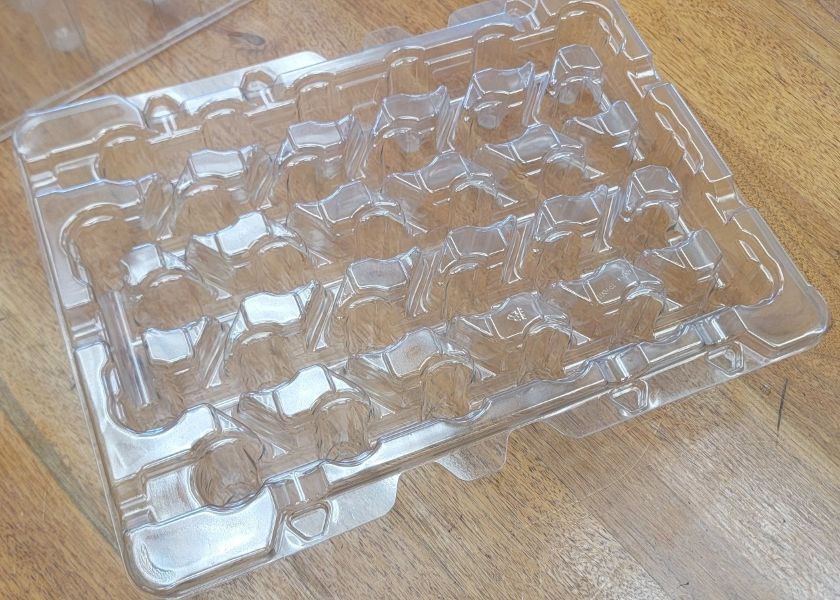
Thermoforming is a highly efficient manufacturing process where a plastic sheet is heated to a pliable
forming temperature, formed to a specific shape in a mold, and trimmed to create a usable product. For
engineers, understanding this process is essential for optimal part design.
Extrusion
Raw PET resin pellets (virgin or PCR) are melted and extruded into a continuous, flat rigid sheet or roll of precise gauge (thickness). An example PET technical data page is here.
Heating
The roll-fed sheet is indexed through a highly controlled oven array, bringing the PET to its precise
glass transition/forming temperature without causing crystallization. PET is more sensitive and requires greater control than styrene or PETG.
Forming
The heated plastic web is positioned over temperature controlled aluminum tooling, with vacuum and often pressure forming the part over the mold. Vacuum Formed Trays Process
Key Engineering Benefits of PET Material when forming Trays
General Note: PET variants provide exceptional physical characteristics that make them suitable for rigorous packaging demands across multiple industries.
- High Impact Resistance – Superior toughness and drop-test performance. Protects heavy or fragile components during aggressive transit scenarios without shattering or cracking.
- Excellent Optical Clarity – Glass-like transparency allows for automated visual inspection systems and zero-error manual identification and barcode scanning directly through the packaging.
- Barrier Properties and Sealability – Inherent resistance to moisture, oxygen, and carbon dioxide transmission, which is vital for maintaining medical sterility or product freshness over extended periods. Seals well against common lidding films.
- Cost-Effective – Generally less expensive than many alternative clear plastics, especially in high-volume runs due to the ability to run on inline equipment.
- Reusable trays can be in .050” or .060” gauge on an inline for significant savings compared to a HDPE or HDMPE
- Chemical resistance – Holds up well against oils, fats, and many common cleaning agents, which is useful across food, medical, and industrial applications.
- Dimensional stability – Maintains its shape and doesn’t warp easily under normal handling and shipping conditions.
- Safety – Link to National Association of PET Container Resources
PET RECYLABILITY
General note: 100% Recyclable and the “1” in the recycling triangle. PET is the most widely recycled plastic in the world. It maintains its structural polymer chain integrity through multiple recycling loops without degradation.
- Related Klockner Pentaplast Blog
Common Applications & Industries of PET Trays and Material
Thermoformed PET trays are specified across diverse sectors due to their versatility and compliance Profile:
- Medical Device Packaging: Used in ISO Class 7/8 cleanrooms for rigid sterile barrier trays (often sealed with Tyvek® lidding). Ensures devices are protected from physical damage and biological contamination.
- Electronics & Semiconductor: When manufactured with inherently static dissipative materials or specialized coatings, PET trays protect sensitive PCBs and microchips from Electrostatic Discharge (ESD). Washable Clear ESD Packaging is available with ESD Properties.
- Industrial Dunnage: Thick-gauge PET trays are used for work-in-progress (WIP) handling. Designed for precise robotic automation, pick-and-place indexing, and repeated localized factory loops. With a high speed inline, materials up to .060” in thickness can be used to form reusable and cost effective trays.
- Retail & Consumer Goods: High-visibility clamshells, blister packs, and multi-cavity sorting trays that require tamper-evidence and premium consumer aesthetic appeal.
Regulatory & Compliance Guide for PET Material and Trays
NOTE: THIS IS A GENERAL GUIDE ONLY. COMPLIANCE IS RESIN, PROCESS, AND APPLICATION DEPENDENT AND SHOULD BE QUALIFIED!
General: Navigating global materials compliance is a primary responsibility for packaging engineers. PET and its variants stand out as one of the most broadly compliant polymer families available globally. The following outlines current compliance statuses. CRUCIAL EU PPWR Packaging and Packaging Waste Regulation: PET/RPET perfectly aligns with stringent EU PPWR mandates for Design for Recycling (DfR). Thermoformed RPET easily meets and exceeds the mandatory Post-Consumer Recycled (PCR) content targets required for the 2030 deadlines.
PFAS (Forever Chemicals) and PET Tray Material
Standard PET, APET, and RPET thermoformed trays are manufactured with “No Intentionally Added PFAS”. They fully comply with aggressive global and state-level bans on forever chemicals in packaging.
RoHS & REACH and PET Tray Material
Fully compliant. PET trays do not contain any Substances of Very High Concern (SVHCs) above threshold limits defined by REACH, nor restricted heavy metals governed by RoHS directives.
California Proposition 65 for PET Tray Material
Standard PET and RPET resins require no warning labels. The base polymer formulation does not contain chemicals listed by California to cause cancer or reproductive harm.
EU MDR (Medical Device Regulation) for PET Tray Material
Virgin APET grades meet strict biocompatibility. Resin dependent and applicable to medical devices. standards (ISO 10993) and provide the absolute lot-to-lot material traceability required under EU MDR frameworks.
POP (Stockholm Convention) for PET Tray Material
PET materials are entirely free from Persistent Organic Pollutants (POPs), complying fully with the international environmental treaty to eliminate hazardous chemicals.
Conflict Minerals for PET Tray Material
PET resin production does not utilize 3TG minerals. Therefore, PET trays are free from Conflict Minerals per Section 1502 of the Dodd-Frank Act.
This information was prepared by the team at ECP Plastic Trays. Contact us with any questions or with your specific application. About Us!