
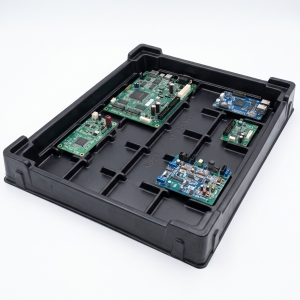
What is Static Electricity and Why Do We Need ESD Safe Shipping Trays? (In simple terms)

Have you ever felt a small “zap” after rubbing your feet on a carpet and touching a doorknob? That static shock, called Electrostatic Discharge (ESD), is harmless to humans but can instantly destroy fragile electronic components.
Because regular plastic generates static electricity, sensitive electronics require ESD-safe trays. These trays act as a shield or sponge, preventing static shocks or safely absorbing and dissipating electricity to protect the parts inside.
What is an ESD Tray?
Electronic components can be damaged by electrostatic discharge even when there is no visible spark and no obvious indication that damage has occurred.
ESD packaging trays are trays designed with controlled electrical properties to help protect electrostatic-discharge-sensitive (ESDS) components from static-related damage. They can provide the physical protection of a conventional thermoformed or molded tray while adding properties intended to control static charging, dissipate electrical charge, or provide other forms of ESD protection.
Where can I find more detailed information on ESD Packaging for Circuit Boards?
ANSI/ESD S541-2026, the current ESD Association standard for packaging materials, defines packaging properties needed to protect ESDS items through production, transport, and storage. It also references test methods and performance limits for evaluating ESD protective packaging.
For engineers, quality managers, and procurement professionals, selecting an ESD tray is more complicated than simply asking whether a tray is “ESD safe.” The appropriate tray depends on the component being protected, where the tray will be used, how the product will be handled, the required electrical properties, mechanical requirements, and the overall ESD control program.
Why is ESD Protection Important?

Static electricity is an electrical charge that builds up on the surface of an object.
You have probably experienced static electricity when walking across a carpet and then touching a metal object. The small shock is caused by an electrostatic discharge—the sudden movement of electrical charge from one place to another.
Static electricity can be created when two materials touch and then separate. This phenomenon is commonly called triboelectric charging.
An electronic component can become electrically charged. If it then contacts another object at a different electrical potential, the stored charge can discharge rapidly. That discharge can damage delicate electronic structures.
The important point is that ESD damage does not necessarily require a visible spark. A component can experience an electrical event that is too small for a person to see or feel but still large enough to affect sensitive electronics.
What Materials are Used for ESD Trays?
Engineers looking to specify ESD trays must choose the correct surface resistance. Surface
resistance is measured in ohms (Ω) and dictates how fast electricity travels across the material. There
are three primary categories:
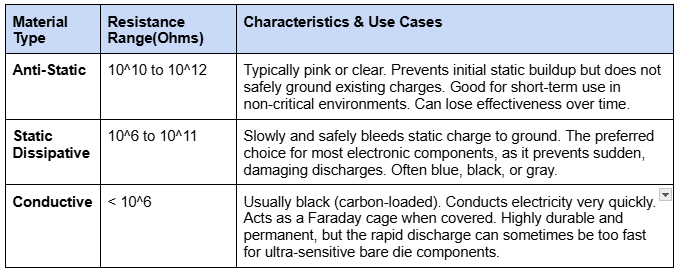
What Is the Difference Between Static Dissipative and Conductive ESD Trays?
One of the most common questions when specifying ESD trays is whether a tray should be static dissipative or conductive. The terms describe different electrical behaviors.
Static dissipative tray
A static dissipative material allows charge to move through the material in a controlled manner. This can help prevent a large charge from remaining concentrated on the tray.
Conductive tray
A conductive material provides a relatively easy path for electrical charge to move. Conductive materials may be appropriate when the packaging system calls for that electrical behavior.
Which one is better?
Neither is automatically “better.” The correct choice depends on the component, handling environment, packaging system, grounding strategy, and applicable ESD requirements.
For this reason, procurement specifications should avoid simply stating: “Supply ESD-safe plastic trays.” A more useful specification identifies the required performance characteristics and applicable standard. The current ANSI/ESD S541-2026 standard defines packaging requirements for ESDS items throughout production, transportation, and storage.
What Should Engineers Consider When Designing an ESD Shipping Tray?
Electrical performance is only one part of successful tray design. An ESD shipping tray must also protect the component physically and function effectively throughout the logistics process.
1. Component geometry
The tray should securely locate the component without creating unnecessary stress or interference.
2. Critical surfaces
The tray should avoid damaging sensitive surfaces, pins, connectors, optical surfaces, leads, or other functional areas.
3. Cavity design
Cavities should provide adequate clearance while preventing excessive movement during transportation.
4. Stackability
Many ESD trays are designed to stack. Stacking features should provide stability without creating excessive pressure on the components.
5. Part presentation
The tray should allow operators or automated equipment to easily load, unload, inspect, and retrieve components.
6. Automation
If the tray will be used in automated production or assembly equipment, dimensional tolerances and tray-to-tray consistency become especially important.
7. Mechanical protection
The tray should provide the required protection against vibration, impact, compression, and handling.
8. Cleanliness
Applications involving semiconductor, medical, aerospace, optical, or other high-value components may have specific cleanliness requirements.
9. Identification
Tray identification may be important for material classification, lot control, traceability, and ESD program requirements. ANSI/ESD S541 includes sections addressing material identification, classification, traceability, and the ESD protective symbol.
How Does Thermoforming Work for ESD Packaging Trays?
Thermoforming is a common manufacturing process for custom plastic trays.
In a simplified thermoforming process, a plastic sheet or roll stock is heated until it becomes sufficiently soft to form. The heated material is then shaped over or into a mold using vacuum, pressure, mechanical assistance, or a combination of methods.
After forming and cooling, the individual trays are trimmed and finished.
For ESD tray applications, the material used for forming must provide the required electrical characteristics while also maintaining the mechanical and dimensional properties needed by the tray design.
Why use thermoformed ESD trays?
Thermoforming can offer several advantages:
- Custom cavity geometry
- Efficient use of material
- Lightweight construction
- Fast design changes
- Suitable economics for many custom applications
- Large tray formats
- Multiple cavities in one tray
- Easy integration of stacking features
- Ability to design around specific component geometry
For packaging engineers, the combination of custom geometry and controlled material properties makes thermoforming an attractive option for many ESD-sensitive products.
What Is the Difference Between an ESD Tray and an Ordinary Plastic Tray?
The physical appearance of an ESD tray and an ordinary plastic tray can be very similar. The difference is primarily in the material properties and the intended performance. A conventional plastic tray may be designed primarily for mechanical protection and product presentation.
An ESD tray is designed with additional electrical-performance requirements intended to reduce the risk of electrostatic damage. This is why replacing an ESD tray with a conventional plastic tray simply because the two trays have the same dimensions can introduce risk.
The packaging material itself can participate in electrostatic charging and discharge events.ANSI/ESD S541 notes that ordinary packaging—including plastic boxes, trays, and clamshells—can be modified to provide static-control properties.
Frequently Asked Questions About ESD Packaging Trays
What is an ESD packaging tray?
An ESD packaging tray is a tray designed with controlled electrical properties to help protect electrostatic-discharge-sensitive electronic components from static-related damage during handling, storage, and transportation.
What is an ESD shipping tray?
An ESD shipping tray is an ESD protective tray specifically designed for moving and transporting electronic components. Depending on the application, it may be part of a larger ESD packaging system that includes shielding, cushioning, cartons, bags, and other protective materials.
Are ESD trays conductive or static dissipative?
ESD trays can be conductive, static dissipative, or designed with other controlled electrical properties. The appropriate property depends on the application and applicable ESD requirements.
Is a static dissipative tray the same as an ESD tray?
Not necessarily. “ESD tray” is a broad application term. A specific tray may use static dissipative material, conductive material, low-charging material, shielding, or a combination of properties.
Do ESD trays protect against physical damage?
They can. ESD trays are often designed to provide both electrical protection and mechanical protection. The level of physical protection depends on the tray design and the shipping environment.
Can thermoformed plastic trays be ESD-safe?
Yes. Thermoformed trays can be manufactured using materials engineered for appropriate ESD-control properties.
What standard applies to ESD packaging?
ANSI/ESD S541 is the primary ESD Association standard for packaging materials used to protect ESDS items. IEC 61340-5-3:2022 is technically equivalent to ANSI/ESD S541.
Does ANSI/ESD S20.20 apply to ESD trays?
ANSI/ESD S20.20 establishes requirements for an overall ESD control program. ESD protective packaging is one part of that broader system. ANSI/ESD S541 addresses packaging materials and their protective properties.
How do I know if an ESD tray is suitable for my component?
Start with the component’s electrical sensitivity, physical geometry, handling environment, shipping conditions, and required ESD protection. Then specify the required material properties, testing, and applicable standards.
What should I ask an ESD tray manufacturer?
Ask about material type, electrical properties, applicable standards, test methods, production testing, traceability, dimensional control, mechanical performance, and whether the tray is intended for use inside or outside an ESD Protected Area.
ESD Packaging Tray Selection: Quick Reference
Question | Why It Matters |
What component is being packaged? | Determines cavity geometry and protection requirements |
How ESD-sensitive is the component? | Establishes the required level of ESD protection |
Where will the tray be used? | Determines application and packaging requirements |
Will it be shipped? | Shipping introduces additional physical and environmental risks |
Is shielding required? | Dissipation alone may not provide all required protection |
Is the material conductive or dissipative? | Determines how electrical charge behaves |
What standard applies? | Establishes measurable performance requirements |
Does the tray need to be tested? | Provides evidence of conformance |
Is the tray reusable? | Affects material selection, durability, and cost |
Will the tray be automated? | Creates dimensional and handling requirements |
Is traceability required? | Supports quality control and supplier management |
Author
Chris Spiegel has 30 years in the thermoformed packaging industry, and has worked on countless ESD Tray projects over the years. He is part of the Engineered Components & Packaging team that compiled this information.